Measuring Impact In The Field
Assessed through direct observation and documented field work
Turn The Tide (TTT) prioritizes measurable, verifiable actions carried out in the field. Rather than relying on assumptions or generalized claims, we document each intervention and report observed outcomes, while remaining transparent about the limits of lionfish control as a management tool.
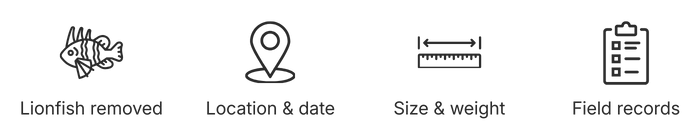
During each dive operation, we collect consistent field data, including:
the number of lionfish removed,
dive locations and dates,
depth ranges,
and individual size and weight when conditions allow.
Field Results To Date
Quantified outcomes from ongoing lionfish removals
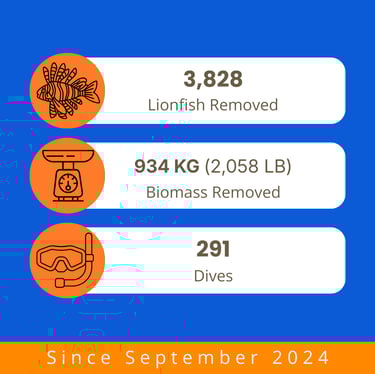
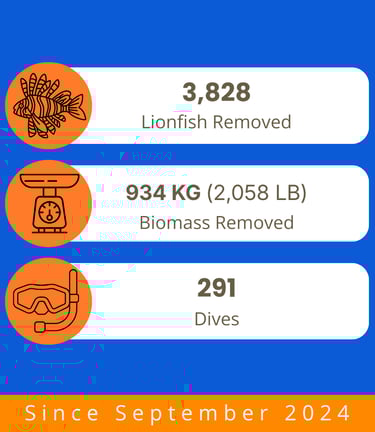
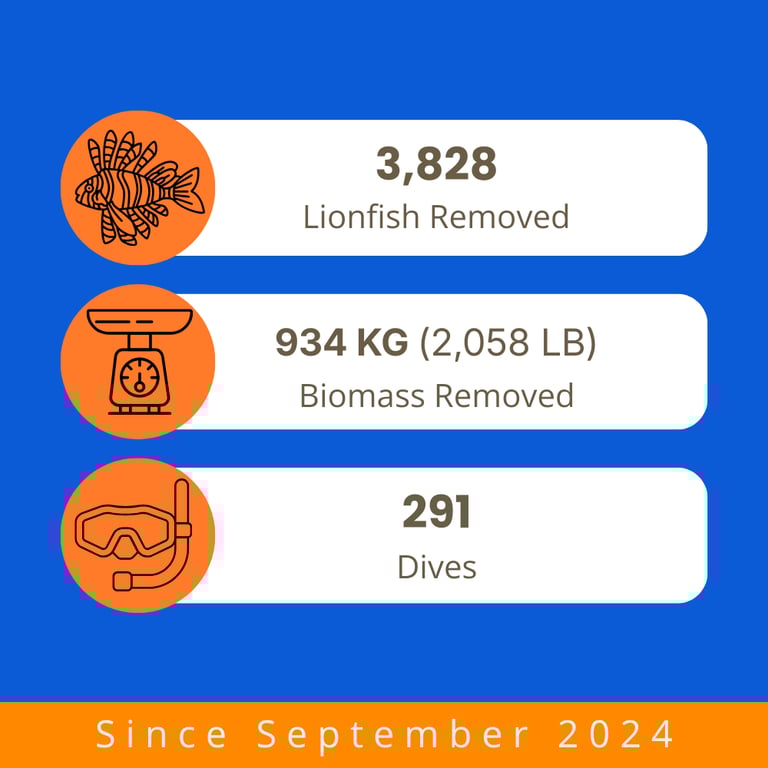
Systematic recording of lionfish removals began on September 3, 2024. To date, approximately 4,000 lionfish — representing close to one metric tonne of biomass — have been removed during roughly 300 documented dives.
These figures reflect direct, site-level interventions conducted as part of routine dive operations. They provide a transparent record of activity to date and establish a baseline against which future efforts and outcomes can be documented and compared.
While each removal is recorded individually, results are assessed in aggregate. Repeated removals are associated with visibly reduced lionfish presence at sites where control is regularly carried out. Observations regarding changes in local predation pressure are qualitative and based on repeated site visits, rather than formal pre- and post-intervention counts.
These observations are consistent with published studies on lionfish impacts, but are reported here as descriptive field observations rather than quantified outcomes.

These standardized data points enable tracking of effort over time, comparison across sites, and contextual interpretation of results. This approach supports accountability, transparency, and collaboration with local stakeholders and authorities.
Our objective is not to overstate impact, but to provide a clear, documented record of actions taken in the field and their immediate context.
How Individual Actions Add Up


Small-scale interventions accumulate into broader ecological effects
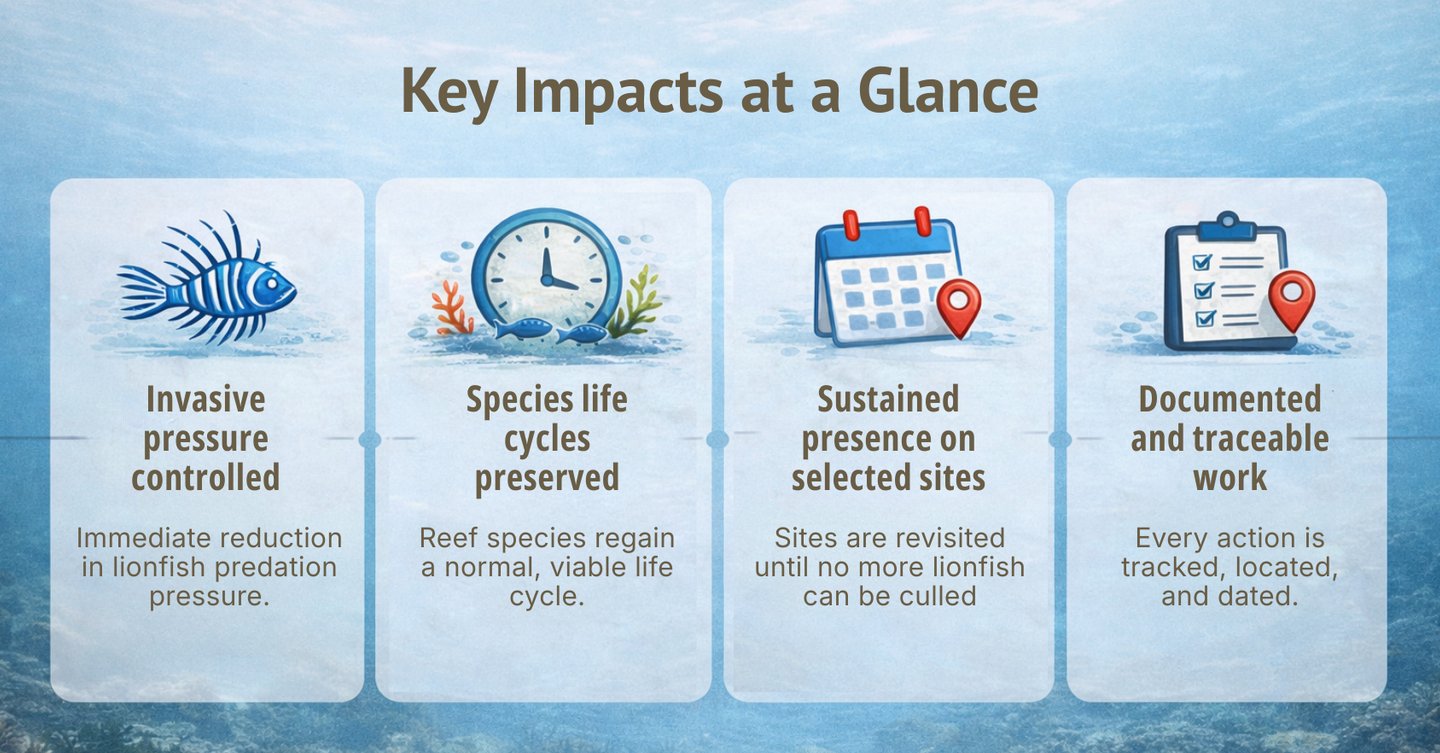
Each lionfish removed represents more than a single intervention. Taken together, repeated removals reduce local predation pressure and improve conditions on the reef over time.
As pressure decreases:
more juvenile reef fish survive, including key herbivores,
grazing activity increases, helping limit algal growth,
corals face less competition and can recover more effectively,
and native fish populations have greater opportunity to persist and reproduce.
At the same time, each removal reduces future reproduction by invasive lionfish.
Larval dispersal links reefs across the Caribbean, meaning localized control efforts can be offset by inaction in neighboring regions.


Dive-level records reflect both localized outcomes and engagement in a shared, regionally connected management challenge. In this context, sustained and cumulative action across sites is essential to achieving measurable impact.
Reef ecosystems are shaped by multiple environmental and biological factors, including biomass recycling. Field observations show that when culled lionfish are left in place under appropriate conditions, several reef species consume them—such as moray eels, spiny lobsters, crabs, octopuses, and various small and large fish—thereby contributing to the local nutrient cycle.
All observations reported here are descriptive, grounded in field records and repeated site visits. They are presented conservatively and do not imply predictive or causal outcomes beyond observed conditions.
Results will continue to be documented over time to support longitudinal comparison and adaptive management.
Data, Collaboration, and Scope
Field-based work gains value through sharing, context, and clear limits
Data Sharing and Collaboration — When relevant, Turn The Tide shares field data and observations with marine biologists, fisheries managers, and local institutions. Our objective is to contribute usable, field-based information that can inform research, support management discussions, and aid decision-making at the local and regional level.
Scope and Limitations — TTT is a field-based initiative led by experienced divers, not a scientific research program. While observations are documented carefully and shared transparently, our role is to support practical action and contribute firsthand information — not to draw scientific conclusions about ecosystem-scale change.
Limits of Lionfish Control —Lionfish control does not address broader drivers of reef decline such as overfishing, climate change, habitat loss, or pollution. Its value lies in reducing a known, localized pressure on reef ecosystems when carried out consistently and responsibly, alongside other conservation and management efforts.
Looking Ahead — TTT’s focus remains on consistency, collaboration, and transparency. Priorities include improving data consistency, strengthening local partnerships, and sharing results in formats that are useful to researchers, managers, and institutions. Progress, for us, is measured by sustained field effort and careful, honest reporting over time.
Contact us to discuss collaboration
— We report what we do, what we observe, and the limits of what can be concluded —
Measuring Impact In The Field
Assessed through direct observation and documented field work
Turn The Tide (TTT) prioritizes measurable, verifiable action in the field. Rather than relying on assumptions, we document each intervention and report observed outcomes, while remaining clear about the limits of lionfish control.
During each dive, we collect consistent field data, including:
Field Results To Date
Systematic recording of lionfish removals began on September 3, 2024. To date, approximately 4,000 lionfish—representing close to one metric tonne of biomass—have been removed across roughly 300 documented dives.
These figures reflect direct, site-level interventions carried out during routine dive operations. They provide a transparent record of activity and establish a baseline for tracking effort and outcomes over time.
Each removal is recorded individually, but results are assessed in aggregate. At sites visited repeatedly, we observe visibly reduced lionfish presence. Changes in local predation pressure are described qualitatively and are based on repeated site visits rather than formal before-and-after surveys.
These observations align with published research on lionfish impacts, but are presented here as field observations, not quantified experimental results.
Field records also include instances where culled lionfish are consumed by reef scavengers—such as morays, lobsters, and snappers—when left on site under appropriate conditions, contributing to localized nutrient cycling.
All information presented is descriptive, conservative, and grounded in documented field work. Results will continue to be recorded to support long-term comparison and adaptive management.

How Individual Actions Add Up


Small-scale interventions accumulate into broader ecological effects
Each lionfish removed represents more than a single intervention. Taken together, repeated removals reduce local predation pressure and improve conditions on the reef over time.
At the same time, each removal reduces future reproduction by invasive lionfish
— Larval dispersal connects reefs across the Caribbean, so inaction nearby can undermine local control efforts —

Dive-level records reflect both localized outcomes and engagement in a shared, regionally connected management challenge. In this context, sustained and cumulative action across sites is essential to achieving measurable impact.
Data, Collaboration,
Field-based work gains value through sharing, context, and clear limits.
Data Sharing and Collaboration — When relevant, Turn The Tide shares field data and observations with marine biologists, fisheries managers, and local institutions. Our objective is to contribute usable, field-based information that can inform research, support management discussions, and aid decision-making at the local and regional level.
Scope and Limitations — TTT is a field-based initiative led by experienced divers, not a scientific research program. While observations are documented carefully and shared transparently, our role is to support practical action and contribute firsthand information — not to draw scientific conclusions about ecosystem-scale change.
Limits of Lionfish Control —Lionfish control does not address broader drivers of reef decline such as overfishing, climate change, habitat loss, or pollution. Its value lies in reducing a known, localized pressure on reef ecosystems when carried out consistently and responsibly, alongside other conservation and management efforts.
Looking Ahead — TTT’s focus remains on consistency, collaboration, and transparency. Priorities include improving data consistency, strengthening local partnerships, and sharing results in formats that are useful to researchers, managers, and institutions. Progress, for us, is measured by sustained field effort and careful, honest reporting over time.
Contact us to discuss collaboration
We report what we do, what we observe, and the limits of what can be concluded.
As pressure decreases:
more juvenile reef fish survive, including key herbivores,
grazing activity increases, helping limit algal growth,
corals face less competition and can recover more effectively,
and native fish populations have greater opportunity to persist and reproduce.
number of lionfish removed
location, date, and depth
size and weight when conditions allow
These standardized data help track effort over time, compare sites, and interpret results in context. They also support transparency and collaboration with local stakeholders and authorities.
Our goal is not to overstate impact, but to provide a clear, documented record of what is done underwater and when.
Quantified outcomes from ongoing lionfish removals efforts
and Scope

© 2026 Turn The Tide Foundation Inc. (TTT), a 501(c)(3) public charity. Donations are tax-deductible to the extent permitted by U.S. law.
We work underwater to actively protect Caribbean reefs from invasive lionfish.
© 2026 Turn The Tide Foundation Inc. (TTT), a 501(c)(3) public charity. Donations are tax-deductible to the extent permitted by U.S. law.