Forms of Collaboration
Working with Turn The Tide — from the reef, onboard, or through field mandates
Turn The Tide (TTT) develops field-based collaborations dedicated to the preservation of Caribbean coral reefs, in partnership with scientists, committed individuals, and institutional stakeholders.
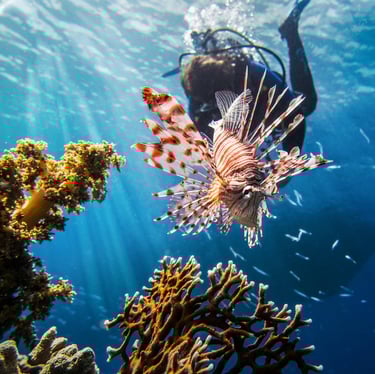
Our work builds on hands-on experience gained through field operations, notably in Saint Lucia and Saint Vincent and the Grenadines, where we collaborate with local actors on lionfish control and reef monitoring programs.
Two main collaboration formats are offered:
Each collaboration is grounded in clear objectives, a field-adapted methodology, and a genuine commitment to reef ecosystems.
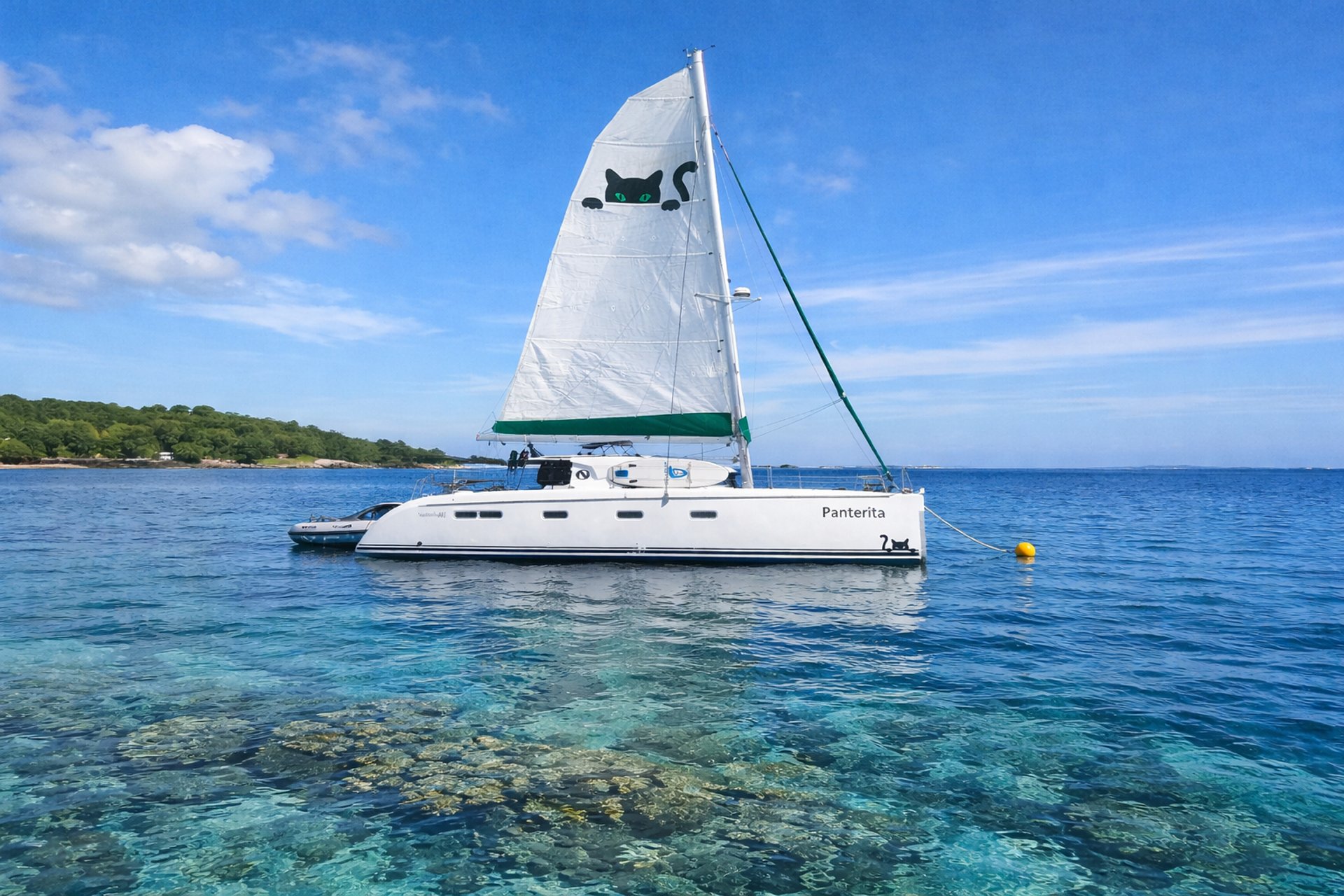
Onboard Panterita — For scientific projects or hands-on field participation carried out in direct immersion on the reefs, within a mobile, autonomous, and structured framework.


Commissioned work — For targeted interventions requested by institutions, NGOs, or local communities: lionfish control, diver training, production of educational materials, or awareness actions.
Field-Based Scientific Collaboration
For universities, researchers, and academic project leaders working in reef environments.
TTT collaborates with universities, research labs, and scientific project leaders seeking to conduct applied research in Caribbean reef ecosystems.
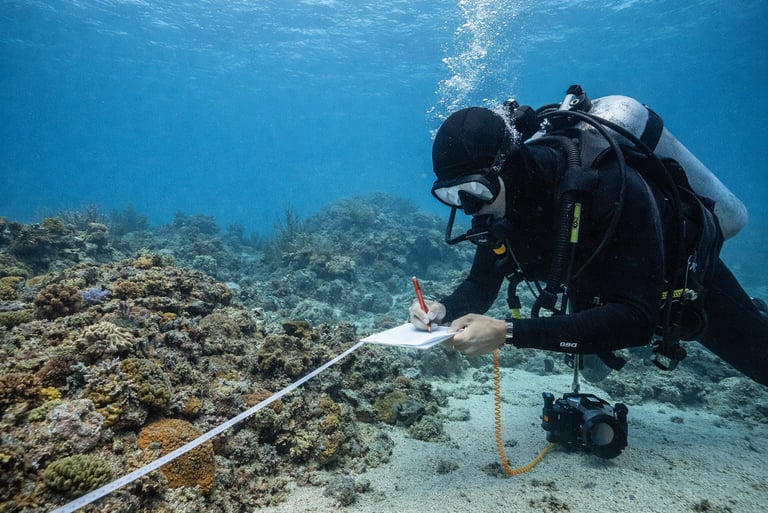
Onboard Panterita, an autonomous, off-grid maritime platform, we provide logistical and operational support enabling access to remote reef sites, repeated dive operations, and data collection under natural conditions.
TTT operates as a field support partner, complementing the scientific protocols defined by the research teams.

Structured project and defined objectives
Each collaboration is based on a clearly defined project, including objectives, field methodology, and a provisional timeline.
Field-oriented design and operational needs
Projects must be designed for effective field implementation and clearly specify logistical, technical, and human requirements. Constraints related to an autonomous, off-grid maritime platform — including limited onboard workspace — must be considered from the project’s outset.
Ecosystem integrity
All proposed methods and interventions must follow strictly non-intrusive practices. Reef preservation takes precedence over any scientific or operational consideration.
Methodology, data, and outcomes
Methods and data management procedures are defined in advance. Collaborations involve the transmission of project results to Turn The Tide, in a format relevant to reef conservation, while respecting academic frameworks and the rights of project leaders.
Feasibility and adaptation to real-world conditions
Projects must account for the realities of the maritime field environment (weather, site access, energy autonomy) and include the capacity to adapt during the mission.
Scientific Collaboration Framework






Participation in Field Missions
For reef enthusiasts who want to contribute concretely to field actions, outside an academic framework.
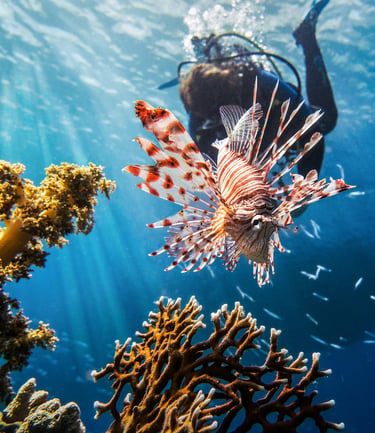
TTT occasionally opens its field missions to highly committed individuals dedicated to reef conservation, without requiring an academic background.
Participation takes place within clearly defined and supervised missions, focused on observation, documentation, support to field interventions, and logistical assistance to ongoing projects.
Requirements to join field missions:
Genuine motivation and active participation, underwater and on the surface
Experienced diver with personal diving equipment
Strict respect for the reef, with no contact or disturbance
Autonomy and team spirit, suited to life onboard
Good physical and mental condition, compatible with fatigue, operational pace, and weather conditions
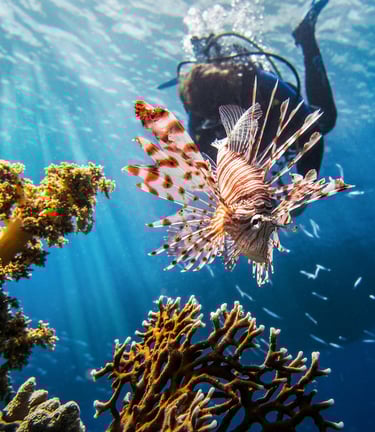
This is not a tourist experience, but a concrete, action-oriented commitment.
Local Programs and Conservation Mandates
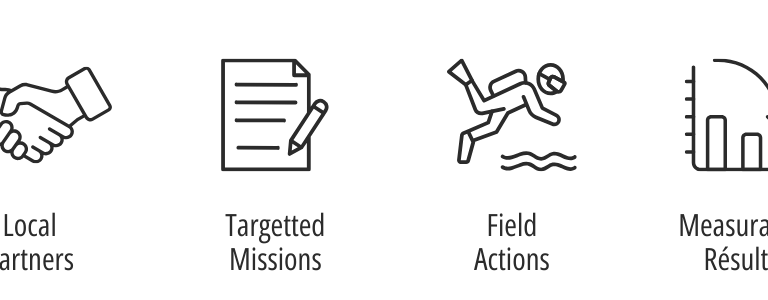
Local partners, field actions, and measurable results for reef protection.
Turn The Tide works with government institutions, NGOs, and local stakeholders seeking to implement or strengthen concrete reef protection actions.
These collaborations take the form of targeted mandates, adapted to local realities, and may be short-term or part of longer-term programs.
TTT operated in Soufrière (Saint Lucia) under a lionfish control mandate, carried out in partnership with the Saint Lucia Fisheries Department and the Soufriere Marine Management Area (SMMA), responsible for the management and conservation of the region’s marine protected areas.
A first operational phase, conducted in summer 2025 over 3.5 months, resulted in:
113 structured dives across 16 sites
1,563 lionfish removed (5–38 cm / 2–15 in)
400 kg of total biomass (880 lb)
In January 2026, Turn The Tide launched a collaboration in Saint Vincent and the Grenadines, under the coordination of the Ministry of Fisheries of Saint Vincent and the Grenadines. The program focuses on lionfish control and reef monitoring, with an approach tailored to the territory’s main challenge: the scale of the marine area to be covered.
In this context, the first phase has been prioritized in the Tobago Cays, in collaboration with the Tobago Cays Marine Park (TCMP), the reserve’s managing authority. Selected for its strict protection status, where all fishing activity is prohibited, the site experiences no fishing pressure—creating particularly favorable conditions for lionfish, with high prey availability.
Objectives of this initial, exploratory and operational phase:
Qualitative observation of juveniles and native species by site
Intensive lionfish removal to reduce predation pressure
Establishment of a comparative baseline to assess future changes
Saint Lucia
Saint Vincent and the Grenadines
Data and observations collected will form the basis for a reassessment at 6–12 months, to analyze relative trends in juvenile and adult native populations and evaluate the effects of actions on reef dynamics.
Beyond lionfish removal, TTT implemented detailed population profiling by dive site to establish a quantitative baseline. This approach—still rarely documented at this operational scale—aims to go beyond simple control efforts to better understand reef population structure.
The data collected will serve as a comparative reference for the second phase planned for 2026, with the objective of assessing population trends and the effectiveness of actions over time.
See the Management Brief - Impact Summary (one page PDF)
The TTT team contributes in several ways — not only underwater:
Building on its field operations, Turn The Tide offers locally adapted mandates to support institutions and organizations ready to move from intention to action.


Reef protection also happens on land, alongside the communities that depend on them.
Going Further — From Action to Knowledge Sharing


Training local divers in responsible lionfish removal, focusing on safe procedures for divers while ensuring strict respect for reef habitats and minimizing disturbance to the ecosystem.
Producing tailored information materials, including public-facing or targeted documentation, as well as fully graphic formats designed for contexts where oral communication and image-based transmission are most effective.
Sharing field experience and raising awareness differently, through experience-based interventions that foster dialogue, exchange, and a concrete understanding of reef conservation issues.
Forms of Collaboration
Working with Turn The Tide — from the reef, onboard, or through field mandates
Turn The Tide (TTT) develops field-based collaborations dedicated to the preservation of Caribbean coral reefs, in partnership with scientists, committed individuals, and institutional stakeholders.
Our work builds on hands-on experience gained through field operations, notably in Saint Lucia and Saint Vincent and the Grenadines, where we collaborate with local actors on lionfish control and reef monitoring programs.
Two main collaboration formats are offered:
Each collaboration is grounded in clear objectives, a field-adapted methodology, and a genuine commitment to reef ecosystems.
For scientific projects or hands-on field participation carried out in direct immersion on the reefs, within a mobile, autonomous, and structured framework.
For targeted interventions requested by institutions, NGOs, or local communities: lionfish control, diver training, production of educational materials, or awareness actions.
For universities, researchers, and academic project leaders working in reef environments.
TTT collaborates with universities, research labs, and scientific project leaders seeking to conduct applied research in Caribbean reef ecosystems.
Onboard Panterita, an autonomous, off-grid maritime platform, we provide logistical and operational support enabling access to remote reef sites, repeated dive operations, and data collection under natural conditions.
TTT operates as a field support partner, complementing the scientific protocols defined by the research teams.


Structured project & clear objectives
Each collaboration is built around a clearly defined project, with objectives, field methodology, and a provisional timeline.
Designed for the field
Projects must be operational from the outset, with clear logistical, technical, and human requirements, while accounting for the constraints of an autonomous, off-grid maritime platform.
Ecosystem integrity first
All methods must remain strictly non-intrusive. Reef preservation takes precedence over any scientific or operational consideration.
Methodology, data & outputs
Methods and data management are defined in advance. Project results are shared with Turn The Tide in formats relevant to reef conservation, while respecting academic standards and project leaders’ rights.
Feasible in real conditions
Projects must reflect real maritime constraints (weather, site access, energy autonomy) and include the ability to adapt during the mission.
Scientific Collaboration Framework





Field-Based Scientific Collaboration
Participation in Field Missions
For reef enthusiasts who want to contribute concretely to field actions, outside an academic framework.
TTT occasionally opens its field missions to highly committed individuals dedicated to reef conservation, without requiring an academic background.
Participation takes place within clearly defined and supervised missions, focused on observation, documentation, support to field interventions, and logistical assistance to ongoing projects.
This is not a tourist experience, but a concrete, action-oriented commitment.
Requirements to join field missions:
Genuine motivation and active participation, underwater and on the surface
Experienced diver with personal diving equipment
Strict respect for the reef, with no contact or disturbance
Autonomy and team spirit, suited to life onboard
Good physical and mental condition, compatible with fatigue, operational pace, and weather conditions
Local Programs and Conservation Mandates
Local partners, field actions, and measurable results for reef protection.
Turn The Tide works with government institutions, NGOs, and local stakeholders to implement or strengthen concrete reef protection actions.
These collaborations take the form of targeted mandates, adapted to local realities, and may be short-term or part of longer-term programs
TTT operated in Soufrière (Saint Lucia) under a lionfish control mandate, in partnership with the Saint Lucia Fisheries Department and the Soufriere Marine Management Area (SMMA), responsible for managing the region’s marine protected areas.
A first operational phase, conducted in summer 2025 over 3.5 months, resulted in:
118 structured dives across ~20 sites
1,584 lionfish removed (5–38 cm / 2–15 in)
400 kg of total biomass (880 lb)
In January 2026, Turn The Tide launched a collaboration in Saint Vincent and the Grenadines, under the coordination of the Ministry of Fisheries of Saint Vincent and the Grenadines.
The program focuses on lionfish control and reef monitoring, with an approach tailored to the territory’s main challenge: the scale of the marine area to be covered.
The first phase is prioritized in the Tobago Cays, in collaboration with the Tobago Cays Marine Park (TCMP), the reserve’s managing authority.
Under strict protection, with all fishing prohibited, the site experiences no fishing pressure—creating highly favorable conditions for lionfish due to abundant prey.
Objectives of this initial exploratory and operational phase:
Qualitative observation of juveniles and native species by site
Intensive lionfish removal to reduce predation pressure
Establishment of a comparative baseline to assess future changes
Saint Lucia
Data and observations will support a 6–12-month reassessment to track trends in juvenile and adult native populations and evaluate the impact of actions on reef dynamics.
Beyond lionfish removal, TTT implemented population profiling by dive site to establish a quantitative baseline, an approach still rarely documented at this operational scale.
The data collected will serve as a comparative reference for the 2026 phase, to assess population trends and the effectiveness of actions over time.
See the Management Brief - Impact Summary (one page PDF)

Saint Vincent and the Grenadines

The TTT team can contribute in several ways — not only underwater:
Building on its field operations, Turn The Tide offers locally adapted mandates to support institutions and organizations ready to move from intention to action.
Training local divers

Reef protection also happens on land, alongside the communities that depend on them.
Going Further — From Action to Knowledge Sharing

Developing tailored resources, from public-facing or targeted documentation to fully graphic formats, designed for contexts where oral communication and image-based transmission are most effective.
Training local divers in responsible lionfish removal, with safe procedures for divers and strict respect for reef habitats, while minimizing disturbance to the ecosystem.
Producing information materials
Raising awareness through experience-based interventions that foster dialogue, exchange, and a concrete understanding of reef conservation issues.
Sharing field experience

© 2026 Turn The Tide Foundation Inc. (TTT), a 501(c)(3) public charity. Donations are tax-deductible to the extent permitted by U.S. law.
We work underwater to actively protect Caribbean reefs from invasive lionfish.
© 2026 Turn The Tide Foundation Inc. (TTT), a 501(c)(3) public charity. Donations are tax-deductible to the extent permitted by U.S. law.